Tankless vs. Tank Water Heaters in Chicago Homes: Which One Actually Makes Sense?
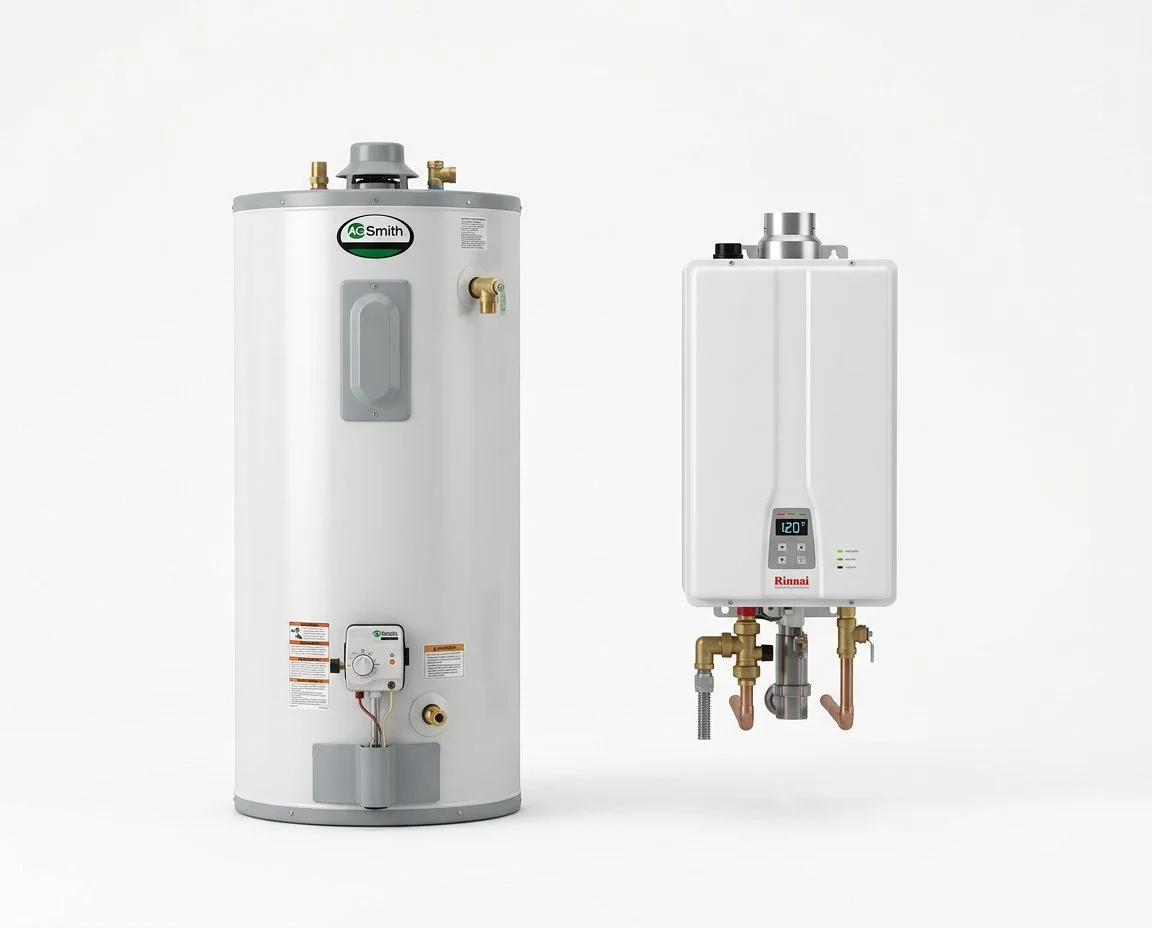
Here's the short answer, because you probably came here for one: for most Chicago-area homes, a quality tank water heater is still the practical choice. Tankless wins in specific situations — and when it's the right call, it's clearly the right call. The trick is knowing which situation you're in before you spend the money.
Let's walk through it the way we would in your basement.
How Each One Works, Briefly
A tank heater keeps 40 to 75 gallons of water hot all the time, ready to go. Simple, proven, cheap to install, and the technology hasn't fundamentally changed in decades because it doesn't need to.
A tankless heater heats water only when you open a tap. No stored reservoir, no standby heat loss, and in theory no running out. It's a smaller unit hanging on the wall where your tank used to squat.
That's the brochure version. The Chicago version has a few wrinkles.
Where Tankless Genuinely Wins
You keep running out of hot water. Three teenagers, back-to-back showers, laundry running at the same time. A properly sized tankless unit just doesn't quit.
You want your basement floor back. In a tight Chicago basement or a finished lower level, reclaiming that corner is worth real money.
You're staying put for a long time. Tankless units often run 20 years or more versus 8 to 12 for a tank. If you're in your forever home, that math starts working in your favor.
Your gas service and venting can support it. This is the one people skip, and it's the one that decides the budget.
Where a Tank Is Still the Smarter Buy
Upfront cost matters. Tank replacement is dramatically cheaper than a first-time tankless conversion, and that gap is mostly installation, not equipment.
Your home wasn't built for tankless. Many older Chicago and near-suburb homes need a larger gas line, new stainless venting through an exterior wall, and sometimes an electrical circuit. Those requirements are why a conversion can cost several times a straight tank swap.
You might sell within a few years. Buyers rarely pay a premium for a tankless unit, so you'd be funding someone else's utility savings.
You want fewer variables. A tank has very little to go wrong, and any plumber in the city can service one at 9 p.m. on a holiday weekend.
The Hard Water Problem Nobody Mentions
This part matters more here than the national articles let on. Water across much of Chicagoland is hard, and hard water is rough on water heaters of both kinds.
In a tank, dissolved minerals settle to the bottom as sediment. That sediment insulates the burner from the water, so the unit works harder, costs more to run, and dies younger. You'll hear it — popping and rumbling during a heating cycle is sediment, not a ghost.
In a tankless unit, minerals scale up inside the heat exchanger, which is the expensive part. Most manufacturers expect an annual descaling flush, and skipping it can void the warranty. That's a genuine ongoing cost and a genuine reason a lot of Chicago homeowners are happier with a tank plus a water softener than with tankless alone.
Either way: flush your tank yearly, and if your water is hard, seriously look at a softener. It protects the heater, the dishwasher, the fixtures, and your patience.
How to Tell Yours Is on the Way Out
It's more than 10 years old — check the serial number sticker, the manufacture date is usually encoded in it
Hot water runs out noticeably faster than it used to
Rusty or metallic-smelling hot water
Popping, rumbling, or banging during heating
Moisture, rust streaks, or pooling anywhere around the base
Pilot light that keeps going out
Any water around the base of a tank is the one that shouldn't wait. Tanks tend to fail all at once, and they hold 50 gallons.
What We'd Recommend, By House
1920s–1950s Chicago bungalow or two-flat: usually a high-quality tank, plus a softener. Conversion costs in these homes are steep, and the venting path is often awkward.
1980s-and-newer suburban home in Naperville, Downers Grove, or Orland Park: tankless becomes a real contender, especially with a full household and a long time horizon. Gas and venting are frequently more cooperative.
Small rental building: tank, nearly always. Simpler, cheaper to service, and no tenant is going to schedule an annual descaling.
Finished basement remodel in Oak Park or La Grange: tankless, if the floor space genuinely changes your plan. Wall-mounting the unit can unlock a layout that pays for itself.
Frequently Asked Questions
-
Tank units typically last 8 to 12 years here, and hard water pushes that toward the low end without annual flushing. Tankless units commonly run 20 years or more with regular descaling.
-
Generally yes, since there's no standby heat loss from keeping 50 gallons hot all day. The monthly savings are real but modest, so they usually don't recover a large conversion cost quickly — they recover it over many years.
-
Because it's often not just the unit. A first-time conversion may need a larger gas line, new stainless venting, condensate drainage, and sometimes electrical work. A like-for-like tank swap needs none of that.
-
Frequently, yes — but it requires an on-site look at your gas meter capacity, gas line size, and a viable venting route. We'll tell you plainly whether your home is a good candidate before anyone talks pricing.
-
Once a year for a tank, and once a year for descaling a tankless unit. In hard-water areas like much of Chicagoland, this is the single highest-return piece of plumbing maintenance you can do.
-
Roughly speaking, a 40-gallon tank suits 1–3 people, 50 gallons suits 3–4, and larger households want 65–75 gallons or a well-sized tankless unit. Bathroom count and simultaneous use matter as much as headcount.
-
Treat it as one. Shut off the water supply to the heater and turn off its gas or breaker, then call us. Tanks generally fail suddenly and completely rather than gradually.
Want a Straight Recommendation?
We'll look at your actual basement, your actual gas line, and your actual hot water habits, then tell you which option we'd choose if it were our house. Sometimes that's the cheaper one. We're fine with that.
Call The Plumb Squad at (312) 278-7900 or request a quote here. We serve Chicago and select western suburbs, including Elmhurst, Hinsdale, La Grange, Downers Grove, Clarendon Hills, Western Springs, Glen Ellyn, Oak Park, River Forest, and Lemont.